The History of Mozart's Requiem
W. A. Mozart (b. Salzburg,1756; d. Vienna,1791) wrote only two Masses on commission: the Waisenhaus Mass, when he was thirteen years old, and the Requiem, the last composition of his life. Count Franz Walsegg zu Stuppach, an aristocrat living in Stuppach Castle near Gloggnitz in Austria, commissioned the Mass for his deceased wife.
Pressed by his obligations to complete two operas, Die Zauberflote, K 620 (1791) and La Clemenza di Tito, K 621 (1791), as well as his Clarinet Concerto in A Major, K 622 (1791), Mozart never finished the Mass beyond the Offertory. The final three sections were provided by Franz Xaver Süssmayr, a student of Antonio Salieri. Süssmayr assisted Mozart as a copyist on the aforementioned operas, and following Mozart’s death, utilized materials from sketches left by Mozart and reworked parts from earlier movements.
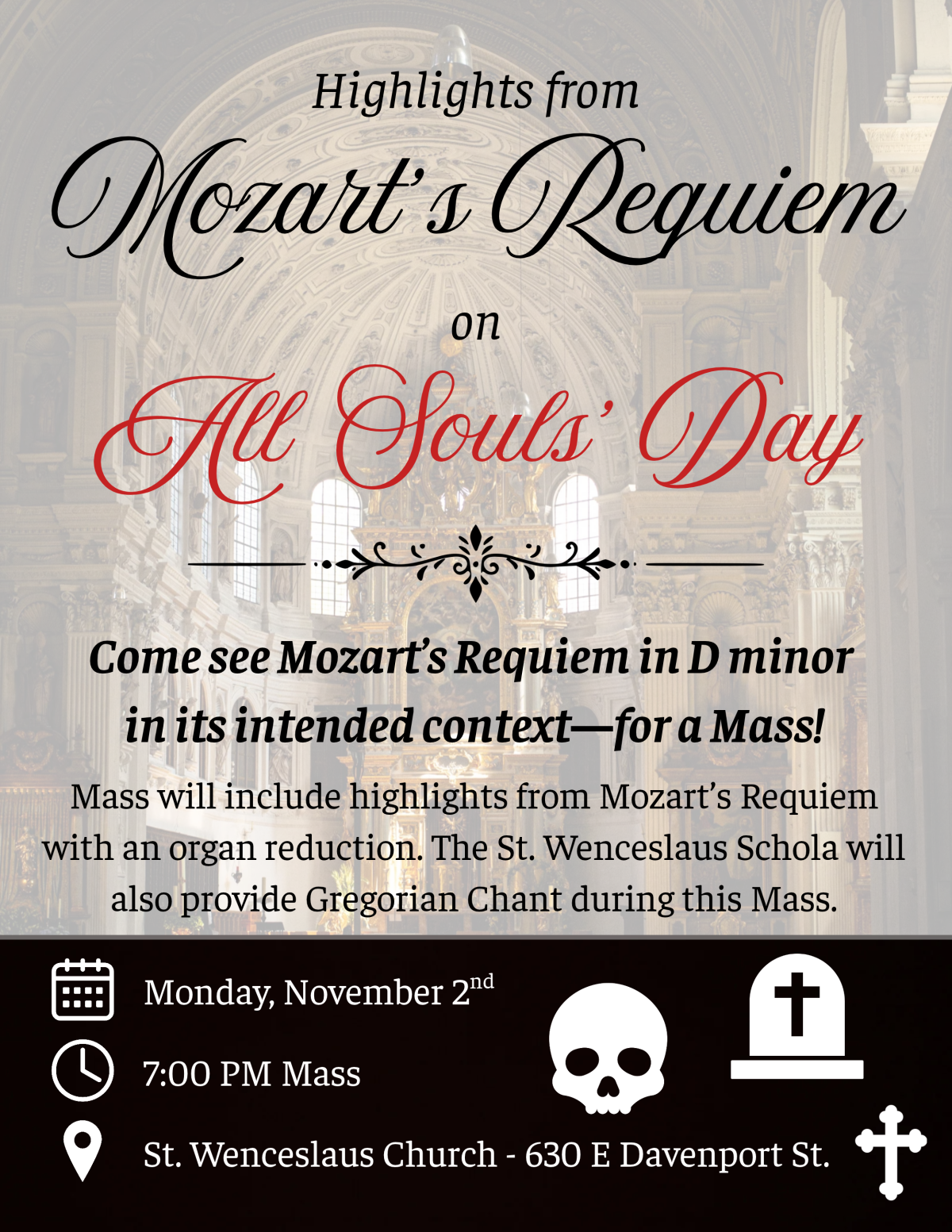
The Requiem highlights we will be doing at St. Wenceslaus are scored for String Quartet, Vocal Quartet, and Organ. The full Requiem is scored for full orchestra, chorus, and solo voices. We will perform 6 movements from the full 14-movement work, with the other movements being replaced by the prescribed Gregorian Chant. The Mass is a liturgical work, fitting for use in worship, yet musically on a plane with the much larger settings of the Requiem texts by Verdi and Berlioz. The fact that Mozart was close to death when he set the texts of his “death mass” to music has been the subject of numerous legends fabricated by “romanticists”. But no stories are needed for such genius.
Truly, Mozart came knocking on the gates of heaven with a plea for entrance accompanied by the music of his Requiem - a cry of such beauty and depth that God (and man) can never cease to find in it a reflection and echo of the infinite mercy of God himself.
(Adapted from an unpublished and undated note by Msgr. Richard J. Schuler, and the Twin Cities Catholic Chorale)